
How does a tone of voice consultant kick-off a project?
Your business coach or fractional CMO says you need to have a tone of voice to build your brand. But what does a tone of voice consultant do?
A good consultant starts with a conversation. They don’t just email you a document. They bring you into the process and set the stage for a close collaboration that will push everyone to deliver a unique and successful tone of voice.
You're paying for the conversation that makes them true: the questions, the disagreement, and the decisions you both sign up to.
Over the next few blogs, you'll understand:
- What is a scope of work, and why your consultant might ask for one
- What is a brief, and why your consultant might ask for one
- What happens in a brand audit?
- Why do you need a brand strategy?
- How does a tone of voice consultant turn into a copywriter?
- What's the value of training your staff when you can just use AI?
This first blog covers the first two on your list.
Scope of work
A scope of work is a simple document that helps everyone understand the minutiae of the project.
For example, do you want your consultant to create one, two, or three options for tone of voice? Make sure this is agreed in the scope of work. Once it's signed off by both parties, everyone knows what the consultant is booked to deliver, what they aren't, and what you're investing.
If your consultant alerts you to the potential for scope creep (when you're asking for more than you've paid for), you can check the scope.
This simple one- or two-page document gives everyone clarity and peace of mind.
In my scope of work docs, clients get a piece that says, "This is inside the scope of work" and "This is outside the scope of work". If we're working on multiple pieces, such as an audit, followed by messaging and tone of voice, and then copywriting, you'll get a scope for the whole project.
Taking a brief for your tone of voice
Even if you've been an absolute angel and written a brief (thank you!), your consultant should take their own brief.
As much as the AI-brofluencers will try to 'remove the pain', the point of a brief is the pain (yes, I did grow up Catholic).
The point of a brief is the pain.
During a briefing process, your tone of voice consultant should be asking you questions such as, 'Why do this project now?', 'How do you know your voice isn't delivering for your business?', and 'What would make this project successful for your business?'
Ideally you'll misunderstand each other, disagree, and get a little frustrated.
That's the point.
Disagreeing is part of taking the brief
This is the time to learn where you say "potato" and they say "pot-a-to". Maybe you're saying, "we need mission, vision, and values and a 'what, how, why' framework as part of this voice project". Your consultant can talk you through why these are two frameworks that help you do one job, and try to understand why your organisation needs this piece of strategy, why you're confused, and which deliverable will fulfil your needs.
For example, mission, vision, and values can take longer to parse, because they're more esoteric. They're also powerful pieces of brand strategy.
Your consultant shouldn't simply agree to everything you suggest.
A 'what, how, why' is also powerful, but more agile. Your consultant should help you understand what you need, they shouldn't simply agree to everything you suggest.
Hopefully the brief can be taken in person, as it helps them to immerse themselves in your brand. Of course, distance and the amount of effort you can invest make a difference here.
By the time your brief is complete, you should have agreed expectations, timing, and what a successful project looks like before your consultant starts reviewing your work.
Many, many briefs
If your project is an audit, tone of voice, and copywriting for your website, I'll take a brief for each of the three stages, and for each page of your site.
It can look like this:
- Week one: Brief for audit
- Week two: Deliver audit
- Week three: Start tone of voice | Take brief for tone of voice
- Week six: Deliver tone of voice
- Week seven: Agree tone of voice | Take brief for first website pages
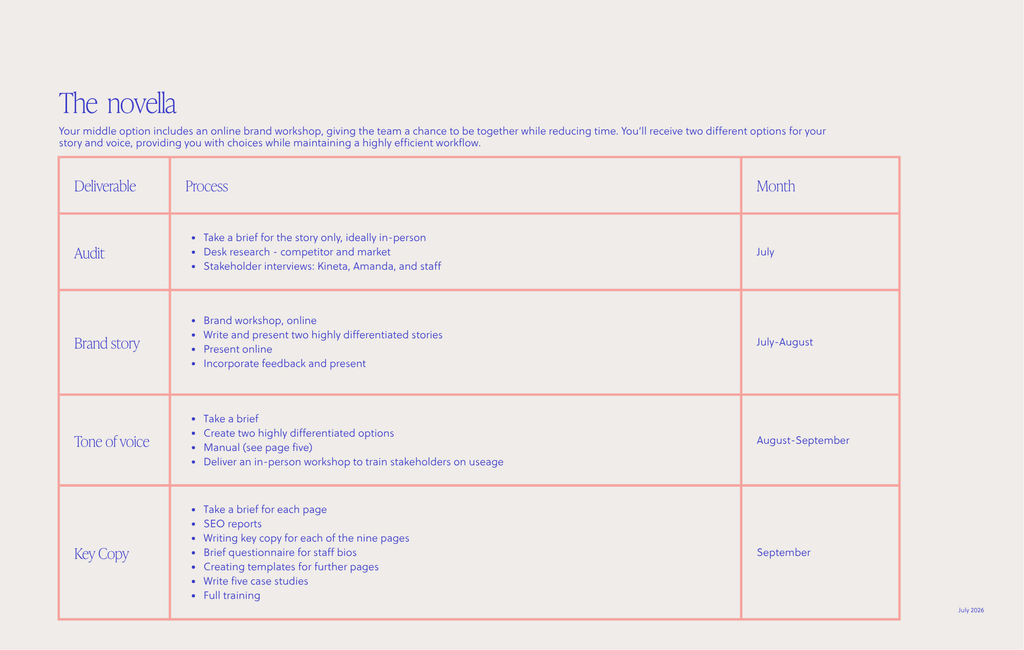
Taking a brief for each phase allows for the inevitable shifts in priorities and thinking. Brand work should trigger new ideas, challenges, and conversations. It should provoke everyone involved to think deeply about what you're doing and why.
Brand work should trigger new ideas, problems, and conversations.
If the needs of your website alter as you work through the branding process, your consultant should work with you to help you manage timelines, schedules, and effort.
The role of generative AI
LLMs synthesise information and make a best prediction about what comes next. This isn't a place where AI is useful, because you need to talk, disagree with, challenge, and be challenged by your consultant.
Writing a scope of work takes a few minutes, as it's likely this information already exists in the proposal you accepted. The brief, also, doesn't take long to write. The documents are quick. The conversation that makes them true is the work.
You need friction to make pearls.
Conversation is key. You need friction to make pearls. This is where the good stuff is.
Walk so you can run
This might sound like a shed-load of admin, but you're making an investment, so you should want to know how your consultant is going to work, and that you're in safe hands.
The next blog in this series is about what happens in a brand audit. Get it in your inbox the day it goes live.
Ann Storr is a tone of voice consultant, writer, and trainer. She helps people transform their businesses by using their own words. You can read more here.