Long, rambling sentences are usually errors. But in her best-selling memoir, ‘A Mind of My Own’, Kathy Burke gives us a masterclass in the form.
Many people love using a run-on sentence because it can evoke an internal world. But why do they work, when are they going to raise the grammar police, and what are the guidelines for brands and writers who want to use the technique with their brand voice to connect with their audience?
Read on, obvs.
Kathy Burke for beginners
Kathy Burke is an award-winning actor, playwright and director. Her memoir sounds so much like her that I imagined her lyrical London voice reading to me (dreamy). Burke uses vignettes (small, vivid stories) to take readers on a journey through her loving but sometimes tricky childhood and early career. The result is a love letter to kindness, family, friends, the arts, London, and the joy of words.
What does Burke’s writing sound like?
The whole book is quotable. Here’s one sweet section from the beginning of the book:
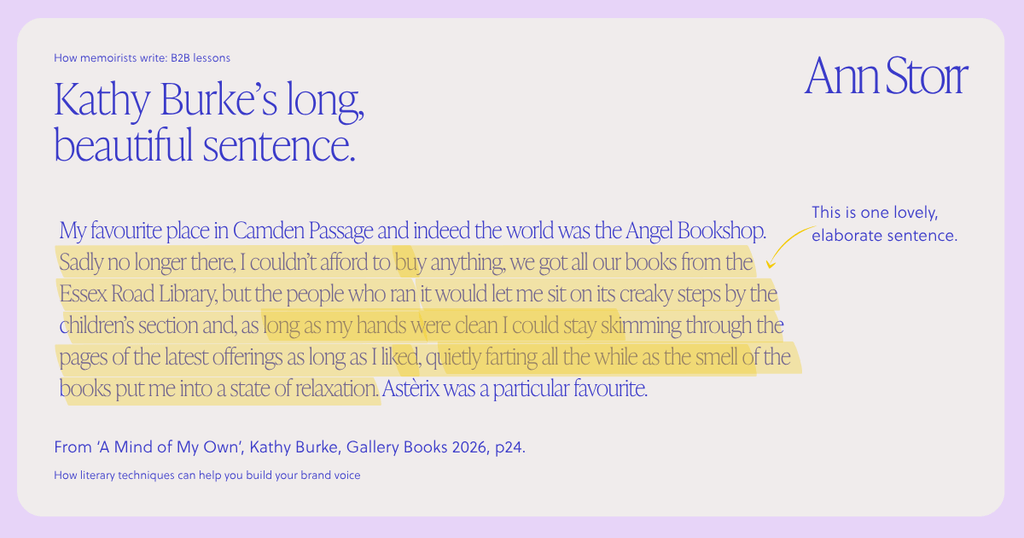
My favourite place in Camden Passage and indeed the world was the Angel Bookshop. Sadly no longer there, I couldn’t afford to buy anything, we got all our books from the Essex Road Library, but the people who ran it would let me sit on its creaky steps by the children’s section and, as long as my hands were clean I could stay skimming through the pages of the latest offerings as long as I liked, quietly farting all the while as the smell of the books put me into a state of relaxation. Astèrix was a particular favourite.
From ‘A Mind of My Own’, Kathy Burke, Gallery Books 2026, p24.
What did you notice? Did you feel how long it is and how rarely it pauses? This long sentence is a joy. Of course it is, it’s Kathy Burke!
Is this a run-on sentence or a comma splice?
Some people might scoff at this as being little more than a comma splice: that is, anyone who writes like this is making a mistake. A comma splice joins two full sentences or clauses with only a comma. A run-on doesn’t have any conjunctions (“and”, “but”) connecting the clauses. Many people call any sentence that keeps going a run-on. Burke’s does a bit of both: a couple of splices, then ‘and’ and ‘but’ carrying it along
But even a ‘grammatically incorrect’ way of extending a sentence, and allowing it to meander, rather longer than one maybe should, to create an effect of someone talking in real time, and taking you on a journey.
Why does it work for Burke?
Burke’s sentences work so well because she combines simple words with literary techniques: details (a bookshop, creaky steps, Astèrix), deflection (bookshop closed, couldn’t afford books, farting), and rhythm (short sentences book-ending the run-on sentence).
You chuckle, and then feel empathy, because little Kathy is relaxed and happy.
Ann Storr
You conjure up a little girl running in, checking her hands, settling onto the creaky steps, spending her time inhaling words. But Burke undercuts any romance, telling us she’s quietly farting. You chuckle, and then feel empathy, because little Kathy is relaxed and happy. The paragraph is wrapped with a nod to Astèrix, which many readers can connect with.
The final sentence is almost perfunctory. In an artist’s memoir, you might expect a rhapsody . But this isn’t her style. She knows it’s time to move on.
How can this technique help my brand?
If you’d like your brand voice to be more conversational and use run-on sentences, you need to understand when it’s the right fit, when it’s not, and how you can start experimenting.
How can I know if run-on sentences are right for my brand?
Run-on sentences envoke an internal monologue because they mimic thought and speech. This is an incredibly intimate relationship. Before you consider experimenting with this technique, ask yourself: will your customers want to experience this intimate connection with my brand?
If your product or service has an emotional benefit that connects with a busy emotional state, this technique could work for you.
But, a note: please don’t just start playing with a brand voice that a professional has created for you. If this voice was built on great customer research and market research, and is delivering agreed results, don’t get “shiny new object syndrome”. Make a note that this is a technique you’d like to try, and bring it to your marketer, copywriter or brand lead.
What could run-on sentences sound like for my brand?
If you want creative, human-sounding copy that uses run-on sentences, think about the Kathy Burke example: use grounding details, simple words, surprising moments, and make sure you have a beginning, middle and end.
This is a voiceover script for a market research brand, where I used a run-on sentence to evoke their way of working, curiosity, and the goal of their audience: to know what their potential customers might be thinking.
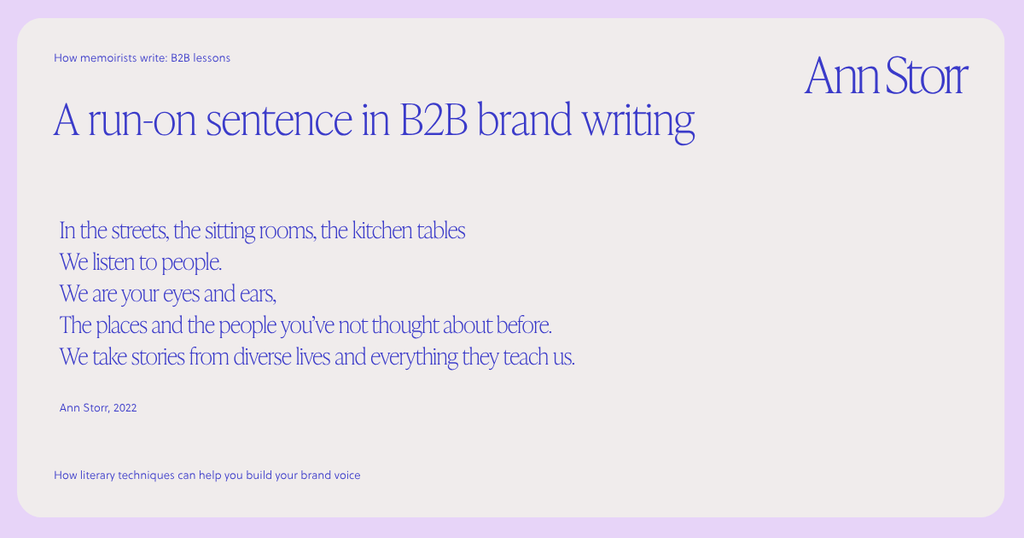
In the streets, the sitting rooms, the kitchen tables
We listen to people.
We are your eyes and ears,
The places and the people you’ve not thought about before.
We take stories from diverse lives and everything they teach us.
It’s a technique that can evoke a sense of flow, movement and energy. And it can connect with your target customer’s intimate internal world.
How can I start experimenting with run-on sentences?
If you’re the brand or marketing person and you want to start using run-on sentences as part of your brand voice, remember that run-ons mimic speech. That means you should start with real speech.
Either record yourself talking about your brand, or even better - with permission, record conversations with your colleagues talking about what you do and why. Even better: organise or find customer interviews where your ideal customer talks about your brand, and how it improves their life. Once they’ve given you consent to record, you can capture their words, rhythms and cadences, so you can connect with your audience.
Then remember the tenants: simple words, jargon if it connects with your ideal customer, rhythm, details, deflection, and narrative structure.
When are run-on sentences a poor choice?
Run-on sentences might not be a good fit if your brand works with High Net Worth Individuals, you’re working in government, or a highly regulated profession. These services demand boundaries and they demand discretion. As such, evoking your customer’s internal stresses is unlikely to create the right emotional resonance for your customers.
Also consider the context. Don’t use run-on sentences for website copy, sales copy, blog posts or articles. These types of communication demand tight copy that readers who are skimming can digest without the effort of untangling run-on sentences.
A run-on sentence isn’t an excuse not to edit your work, or to publish an article that subjects readers to your internal monologue. It’s also not a reason to write long, verbose sentences that, although they contain useful information and moments of real wit and levity, demand that your reader goes back to the beginning to try, if they can, to remember where they started.
Human voices connect
Sounding human is one of the biggest challenges for many brands. As LLM use becomes more and more obvious, and we slip into ‘Black Mirror’-esque worlds where the highest rate of therapy is from corporate computers designed to build parasocial relationships, building human connections becomes more and more important.
We build these links by sharing words, emotions, and moments that touch hearts and minds - a market research company conjuring up the wonder of real people, or Kathy Burke writing about the calming scent of new books.
If your brand is ready for a run-on sentence, just remember to have fun, edit, and read out your work. You could just make something that, if you’re lucky, be a sentence that allows you, and your brand, to fly.
--
Ann Storr is a tone of voice consultant, writer, and trainer. She helps people transform their businesses by using their own words. You can read more here.